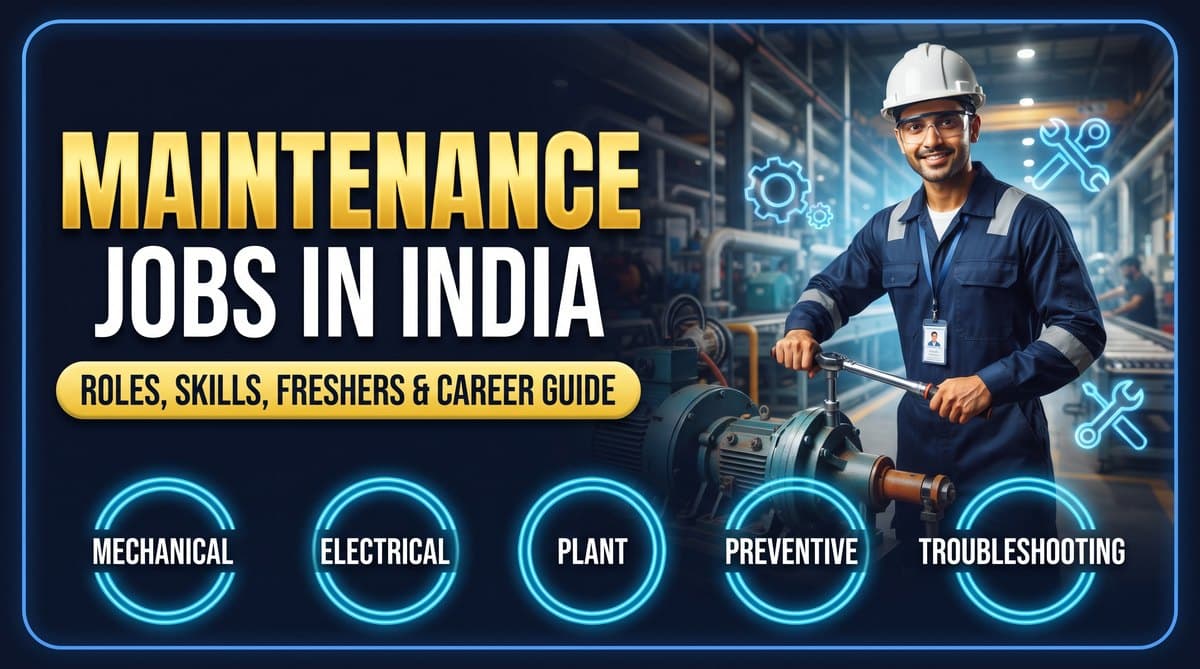
What Are Maintenance Jobs?
Maintenance jobs involve inspecting, servicing, troubleshooting and repairing equipment, machinery and industrial systems to help keep operations safe and reliable. In India, maintenance professionals work across manufacturing plants, automotive facilities, industrial equipment companies, utilities, infrastructure and other technical industries. For the wider picture, see our guides to engineering jobs in India and engineering jobs for freshers.
Maintenance jobs are available for ITI candidates, diploma holders, engineering graduates and experienced professionals, depending on the employer and position. Common roles include Maintenance Technician, Mechanical Maintenance Engineer, Electrical Maintenance Engineer, Plant Maintenance Engineer and Maintenance Supervisor.
For candidates interested in practical engineering work, maintenance can offer a career path that combines technical knowledge, problem-solving, equipment reliability and industrial operations.
Types of Maintenance Jobs in India
Maintenance is a broad technical field. Candidates should identify the type of equipment or system they want to work with before applying for positions.
1. Mechanical Maintenance Jobs
Mechanical maintenance professionals inspect and maintain machines, mechanical assemblies, pumps, motors, gearboxes, conveyors and other equipment.
Typical responsibilities include:
- Inspecting machinery for wear, damage or abnormal operation.
- Identifying mechanical faults and supporting repairs.
- Checking bearings, belts, couplings and lubrication systems.
- Assisting with equipment installation and alignment.
- Performing preventive maintenance activities.
- Recording maintenance work and reporting recurring problems.
Mechanical maintenance roles may suit ITI candidates, diploma holders and mechanical engineering graduates, depending on the job requirements.
2. Electrical Maintenance Jobs
Electrical maintenance professionals maintain electrical equipment, control panels, motors, wiring systems and other electrical installations.
Common responsibilities include:
- Inspecting electrical systems and equipment.
- Assisting with fault identification and troubleshooting.
- Supporting motor and electrical panel maintenance.
- Performing scheduled inspection and maintenance tasks.
- Following electrical safety procedures and isolation requirements.
- Documenting faults, repairs and inspection results.
Candidates applying for electrical maintenance jobs should understand electrical fundamentals and workplace safety. Some duties require specific qualifications, authorisations or licences under applicable regulations.
3. Plant Maintenance Jobs
Plant maintenance teams help keep production facilities and industrial equipment operational. Their work may involve mechanical, electrical, instrumentation and utility systems.
Typical duties include:
- Coordinating planned maintenance activities.
- Supporting production teams during equipment breakdowns.
- Inspecting plant machinery and utility systems.
- Monitoring recurring equipment failures.
- Maintaining service records and maintenance schedules.
- Coordinating with technicians, engineers and external service providers.
Plant maintenance positions may be available in manufacturing, automotive, processing and other industrial environments.
4. Maintenance Technician Jobs
Maintenance technicians perform practical inspection, servicing, repair and troubleshooting tasks. Their responsibilities depend on the equipment, industry and level of experience.
Typical work may include:
- Routine equipment checks.
- Replacing worn or damaged components.
- Assisting engineers with repairs.
- Using hand tools and measuring instruments.
- Following maintenance checklists.
- Reporting equipment abnormalities.
ITI and diploma qualifications may be relevant for technician roles, but eligibility should always be checked against the individual vacancy.
5. Industrial Equipment Maintenance Jobs
Industrial equipment maintenance professionals work with machinery and systems used in manufacturing and industrial operations.
Depending on the employer, equipment may include compressors, pumps, hydraulic systems, pneumatic equipment, conveyors, production machinery and material-handling systems.
Candidates should understand the equipment used in their target industry and develop practical troubleshooting skills relevant to that machinery.
Maintenance Jobs for Freshers
Freshers can explore entry-level maintenance opportunities when they meet the employer's qualification and skill requirements. Relevant vacancies may be advertised under different job titles, so candidates should search beyond the phrase “maintenance engineer.”
Possible entry-level titles include:
- Maintenance Trainee
- Junior Maintenance Engineer
- Maintenance Technician
- Graduate Engineer Trainee — Maintenance
- Mechanical Maintenance Trainee
- Electrical Maintenance Trainee
- Plant Maintenance Trainee
- Service and Maintenance Technician
These are examples of job titles, not a guarantee that every role is currently available.
Skills Freshers Should Develop
Candidates entering maintenance should focus on the fundamentals before trying to learn every industrial tool or system.
Technical fundamentals
- Basic mechanical or electrical engineering principles.
- Understanding of engineering drawings and equipment manuals.
- Familiarity with common industrial components.
- Basic troubleshooting and fault identification.
- Understanding of preventive maintenance.
Practical skills
- Safe use of appropriate tools and instruments.
- Careful inspection and observation.
- Accurate maintenance documentation.
- Clear communication with production and maintenance teams.
- Following standard operating procedures.
Workplace safety
- Understanding site safety rules.
- Following lockout/tagout or equivalent energy-isolation procedures where applicable.
- Using required personal protective equipment.
- Reporting unsafe conditions and equipment defects.
Freshers should mention relevant academic projects, internships, workshop experience and technical training on their resumes. They should not claim practical experience with equipment or systems they have not used.
Maintenance Jobs After ITI, Diploma and BTech
The qualification required for a maintenance position depends on the employer, equipment, industry and responsibilities of the role.
Maintenance Jobs After ITI
ITI candidates may find relevant opportunities in technician, fitter, electrician, service and equipment maintenance roles where their trade and qualifications match the vacancy.
Useful preparation includes:
- Trade-specific technical fundamentals.
- Practical tool handling.
- Equipment inspection and servicing.
- Industrial safety.
- Basic fault diagnosis.
Maintenance Jobs After Diploma
Diploma holders in mechanical, electrical or related engineering disciplines can explore technician, junior engineer, maintenance trainee and equipment servicing positions.
Candidates should review whether the vacancy requires experience, shift availability, specific technical knowledge or familiarity with particular machines.
Maintenance Jobs After BE or BTech
Engineering graduates may explore Maintenance Engineer, Graduate Engineer Trainee, Plant Maintenance Engineer and other engineering-level positions, depending on the employer.
Useful areas of preparation include:
- Equipment reliability and failure analysis.
- Preventive and corrective maintenance.
- Engineering drawings and technical documentation.
- Root cause analysis.
- Maintenance planning.
- Industrial safety and coordination.
A degree alone does not guarantee eligibility for every engineering role. Applicants should match their qualifications and skills to the job description.
Preventive Maintenance vs Breakdown Maintenance
Understanding maintenance approaches can help candidates prepare for interviews and identify the type of work involved in a vacancy.
| Maintenance type | Meaning | Example |
|---|---|---|
| Preventive maintenance | Planned work carried out at scheduled intervals or according to defined operating criteria | Inspecting and servicing a pump according to its maintenance schedule |
| Breakdown maintenance | Work performed after equipment fails or stops functioning correctly | Troubleshooting a conveyor after an unexpected failure |
| Predictive maintenance | Using condition data to help identify developing equipment problems | Analysing vibration trends to identify a potential bearing issue |
| Corrective maintenance | Work performed to correct an identified fault or deficiency | Replacing a damaged component found during an inspection |
Many industrial maintenance teams use a combination of these approaches. The method depends on equipment criticality, operating conditions, safety requirements and the organisation's maintenance programme.
Important Tools and Skills for Maintenance Engineers
The tools and systems required for maintenance jobs vary by role. Candidates should prioritise those relevant to their target equipment and industry.
1. Hand Tools and Measuring Instruments
Maintenance technicians and engineers may use appropriate spanners, screwdrivers, torque tools, callipers, micrometers and other instruments. Correct selection and safe use are important.
2. Engineering Drawings and Manuals
Reading equipment manuals, assembly drawings, electrical diagrams and maintenance instructions helps professionals understand systems and carry out work accurately.
3. CMMS and Maintenance Records
A Computerised Maintenance Management System (CMMS) helps organisations manage work orders, equipment histories, preventive maintenance schedules, spare parts and maintenance records.
Candidates applying for planning or engineering roles may benefit from understanding the purpose of these systems.
4. PLC and Industrial Automation Fundamentals
Basic knowledge of programmable logic controllers (PLCs), sensors and control systems can be useful for maintenance roles involving automated production equipment. The depth of knowledge required depends on the vacancy.
5. Troubleshooting and Root Cause Analysis
Maintenance professionals need to distinguish between symptoms and possible causes. Structured troubleshooting, accurate observations and root cause analysis can help teams address recurring failures rather than repeatedly fixing the same symptom.
6. Safety and Documentation
Safety procedures, equipment isolation, inspection records and clear maintenance reports are essential parts of industrial maintenance work.
Which Industries Hire Maintenance Professionals?
Maintenance professionals may find opportunities across several industries, including:
Manufacturing: Maintenance of production machines, conveyors, utilities and plant equipment.
Automotive: Support for assembly lines, machine tools, production systems and industrial equipment.
Industrial machinery: Servicing and maintaining pumps, compressors, gearboxes and other equipment.
Electrical and automation: Maintenance of electrical installations, control panels, motors and automation systems.
Process industries: Maintenance of equipment and utilities used in industrial processing, subject to role-specific qualifications and safety requirements.
Facilities and infrastructure: Maintenance of building services, utility equipment and facility systems.
The responsibilities and qualifications vary significantly between industries. Candidates should research the equipment, working conditions and safety expectations associated with each position.
How to Find Maintenance Jobs in India
A focused search can help candidates identify positions that match their qualifications, technical skills and preferred location.
Step 1: Choose Your Maintenance Specialisation
Decide whether you want to focus on mechanical, electrical, plant, industrial equipment or facilities maintenance.
Step 2: Search Using Relevant Job Titles
Try a combination of terms such as:
- Maintenance jobs for freshers
- Mechanical maintenance engineer jobs
- Electrical maintenance jobs
- Maintenance technician jobs
- Plant maintenance engineer jobs
- Maintenance jobs after diploma
- Graduate Engineer Trainee maintenance
- Industrial maintenance jobs
Step 3: Filter by Qualification and Experience
Read each job description carefully. Check whether the employer accepts ITI, diploma, BE/BTech or other qualifications, and whether the role requires previous industrial experience.
Step 4: Search by Location
Use the city or industrial area relevant to your job search. For example, candidates may search for maintenance engineer jobs in Pune, Mumbai, Bengaluru, Chennai or Hyderabad, depending on their relocation preferences.
These are suggested search locations, not statements about current vacancy numbers.
Step 5: Prepare a Relevant Resume
Include:
- Your qualification and technical specialisation.
- Relevant internship or work experience.
- Equipment or systems you have genuinely worked with.
- Technical training and certifications.
- Academic projects related to machinery, electrical systems or automation.
- Safety training, where applicable.
Step 6: Review the Job Description Before Applying
Check the required qualification, experience, technical skills, work location, shift expectations and responsibilities. Apply to positions that reasonably match your profile.
Maintenance Engineer Interview Preparation
Maintenance interviews often assess technical fundamentals, practical troubleshooting, safety awareness and the candidate's ability to explain their approach to equipment problems.
Prepare the following topics according to your target role.
For mechanical maintenance
- Bearings, lubrication and couplings.
- Pumps, motors and gearboxes.
- Preventive maintenance.
- Alignment and vibration basics.
- Mechanical drawings and equipment manuals.
For electrical maintenance
- Electrical fundamentals.
- Motors and control panels.
- Basic electrical troubleshooting.
- Electrical safety and isolation.
- Sensors and control-system fundamentals, where relevant.
For plant maintenance
- Maintenance schedules and work orders.
- Breakdown reporting.
- Root cause analysis.
- Spare-parts coordination.
- Communication with production teams.
Common Maintenance Interview Questions
- What is preventive maintenance?
- What is the difference between preventive and breakdown maintenance?
- How would you approach troubleshooting a machine that has stopped unexpectedly?
- Why is lubrication important in mechanical equipment?
- What information should a maintenance report contain?
- What is root cause analysis?
- Why are safety procedures and energy isolation important during maintenance?
- What is a CMMS, and how is it used?
- How would you respond if the same equipment fault occurred repeatedly?
- What should you do if you identify an unsafe condition during inspection?
Candidates should practise answering with clear examples. Freshers can use academic projects or training experiences where appropriate, while experienced applicants should describe real work they have performed without disclosing confidential employer information.
Career Growth in Maintenance
A possible maintenance career path is:
Trainee / Technician → Junior Engineer → Maintenance Engineer → Senior Engineer / Specialist → Maintenance Supervisor / Manager
This is a general example, not a fixed progression. Career paths depend on qualifications, industry, experience, organisational structure and demonstrated skills.
With experience, professionals may specialise in:
- Mechanical or electrical maintenance.
- Plant maintenance.
- Equipment reliability.
- Preventive and predictive maintenance.
- Maintenance planning and scheduling.
- Industrial automation.
- Service engineering.
- Maintenance supervision and operations.
Developing technical depth, safety awareness, troubleshooting ability and maintenance-planning skills can support long-term professional growth.
How techlyz.com Can Help Maintenance Job Seekers
techlyz.com is a dedicated technology and engineering job platform. Candidates can search for maintenance, plant, mechanical and electrical roles by job title, qualification, experience and location, then read the full job description before applying.
Start with mechanical engineer jobs, electrical engineer jobs or jobs for freshers, and narrow the results by city, for example jobs in Pune or jobs in Chennai. Related career guides: mechanical engineering jobs, electrical engineering jobs, production engineering jobs and quality control jobs.
Frequently Asked Questions
1. What do maintenance engineers do?
Maintenance engineers inspect, service, troubleshoot and repair machinery, electrical systems and plant equipment so that production runs safely and with minimum downtime. They also plan preventive maintenance, keep maintenance records and investigate recurring failures.
2. Are maintenance jobs available for freshers in India?
Yes. Freshers can search for Maintenance Trainee, Junior Maintenance Engineer, Maintenance Technician and Graduate Engineer Trainee (Maintenance) roles where the employer accepts entry-level candidates.
3. Can I get a maintenance job after ITI or diploma?
Yes. ITI candidates may qualify for technician, fitter and electrician roles, and diploma holders in mechanical or electrical engineering can apply for technician, junior engineer and maintenance trainee positions, depending on the vacancy requirements.
4. Which skills are needed for maintenance jobs?
Useful skills include mechanical or electrical fundamentals, reading drawings and equipment manuals, safe use of tools and measuring instruments, troubleshooting, preventive maintenance, root cause analysis, safety procedures and clear maintenance documentation.
5. What is the difference between preventive and breakdown maintenance?
Preventive maintenance is planned work done at scheduled intervals to reduce the chance of failure. Breakdown maintenance is work carried out after equipment has already failed or stopped working correctly.
6. What is the difference between mechanical and electrical maintenance?
Mechanical maintenance focuses on machines and mechanical parts such as pumps, gearboxes, bearings and conveyors. Electrical maintenance focuses on motors, control panels, wiring and electrical installations, and usually requires strict electrical safety and isolation procedures.
7. Is PLC knowledge required for maintenance jobs?
Not for every role. Basic PLC, sensor and control-system knowledge is useful for maintenance positions that support automated production lines, and some employers list it as a requirement. Check each job description.
8. How can I find maintenance jobs in India?
Choose a specialisation, search with specific titles such as “mechanical maintenance engineer” or “maintenance technician”, filter by qualification, experience and city, prepare a focused resume and apply to vacancies that match your profile on engineering job platforms such as techlyz.com.
Conclusion
Maintenance jobs in India offer practical engineering careers across manufacturing, automotive, industrial machinery, utilities and facilities. Roles range from maintenance technician and trainee positions to maintenance engineer, reliability and supervisory jobs.
ITI candidates, diploma holders and BE/BTech graduates can all find suitable entry points by building strong fundamentals, safe working habits and hands-on troubleshooting skills, and by matching their qualifications to each job description.
A focused search, a relevant resume and good interview preparation can help candidates find the right opportunity. techlyz.com can support that search with engineering-focused job categories and listings.